<?xml version="1.0" encoding="utf-8"?><feed xmlns="http://www.w3.org/2005/Atom" ><generator uri="https://jekyllrb.com/" version="4.3.3">Jekyll</generator><link href="https://demotive.com/feed.xml" rel="self" type="application/atom+xml" /><link href="https://demotive.com/" rel="alternate" type="text/html" /><updated>2024-03-16T10:53:27+00:00</updated><id>https://demotive.com/feed.xml</id><title type="html">Demotive</title><subtitle>Toiling since 1975</subtitle><author><name>Mat Johnson</name></author><entry><title type="html">Weeknotes for week ending 15 March 2024</title><link href="https://demotive.com/posts/2024/03/15/weeknotes-week-ending-15-march-2024/" rel="alternate" type="text/html" title="Weeknotes for week ending 15 March 2024" /><published>2024-03-15T00:00:00+00:00</published><updated>2024-03-15T00:00:00+00:00</updated><id>https://demotive.com/posts/2024/03/15/weeknotes-week-ending-15-march-2024</id><content type="html" xml:base="https://demotive.com/posts/2024/03/15/weeknotes-week-ending-15-march-2024/"><![CDATA[<p>First up thank you <a href="https://gilest.org/">Giles</a> for popping <a href="https://bsky.app/profile/gilestur.bsky.social/post/3knfx6zjf2l2f">something of a nudge on bluesky</a> about weeknotes. Here’s my weeknotes.</p>

<hr />

<h2 id="at-work">At work</h2>

<p>As mentioned last time I’m now part of a team working on First Contact™.</p>

<p>To recap:</p>

<blockquote>
<p>Every day, patients and the people who care for them seek help from the NHS for new or recurring health problems.</p>
<p>Often they don’t know the right place to start, how urgent their problem really is, or what to expect.</p>
<p>When their needs aren’t met on <b>first contact,</b> some people:</p>
<ul>
<li>keep trying the same service</li>
<li>try multiple methods that don’t join up</li>
<li>give up and don’t get the help they need</li>
</ul>
<p>For patients, poor, disconnected experiences can contribute to worsening health problems and avoidable harm.</p>
<p>For the NHS, this creates inefficiency, wastes valuable resources, and impedes access to equitable, timely, appropriate care.</p>
</blockquote>

<p>I’ve been writing our newsletters to share what we’re up to within the org, and I’ll take this opportunity to steal a taster…</p>

<hr />

<h3 id="we-can-be-out-of-sync-with-patients-sense-making-behaviour">We can be out of sync with patients’ sense-making behaviour</h3>

<div class="full-width">
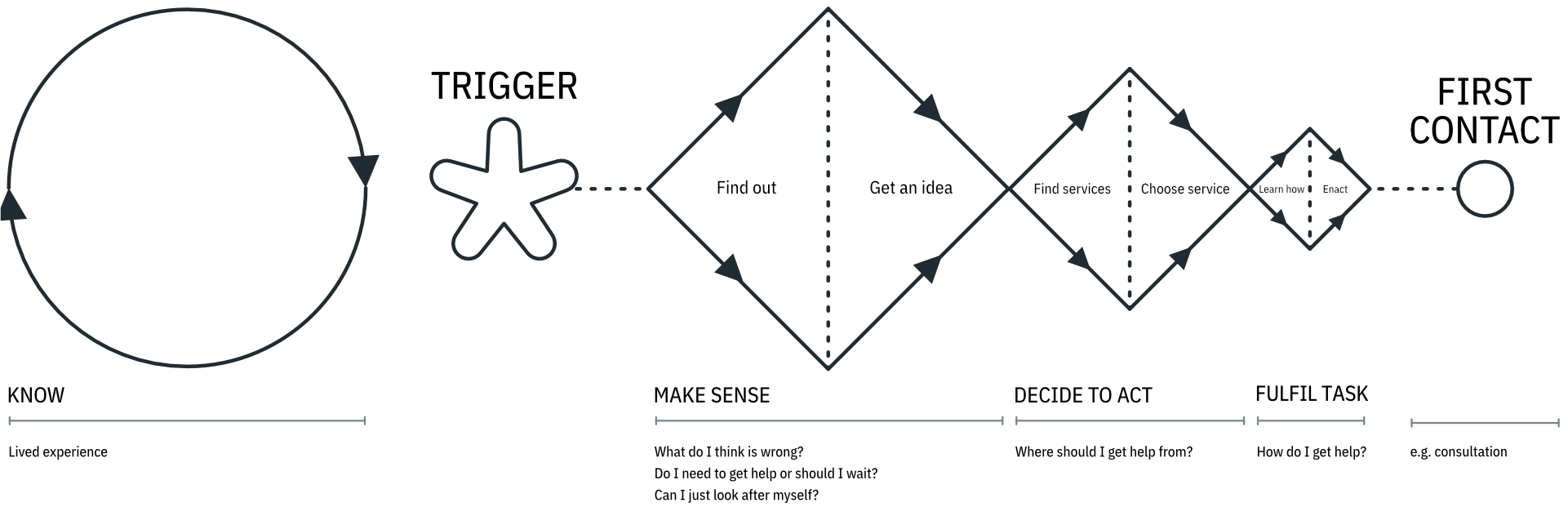
  <img src="/images/weeknotes-15-03-2024.png" alt="Diagram depicting the series of stages: trigger, making sense, deciding to act, fulfilling the task, first contact" loading="lazy" />
</div>

<p>People go through a series of stages in seeking out a “first contact” with healthcare:</p>

<ul>
  <li><strong>Know:</strong> people’s lived experience, learned “formulas” of how and where to get help, and their current situation heavily influences how they make sense of their symptoms</li>
  <li><strong>Trigger:</strong> the change in how someone feels, for whatever reason (illness, injury, etc.) that starts the process</li>
  <li><strong>Make sense:</strong> people may well self-care and wait and see, talk to their friends, family and community, and do their own research (such as web searching for information)</li>
  <li><strong>Decide to act:</strong> if they’re not getting better, people can ‘decide to act’ which is likely to involve the need to talk to someone. We refer to this as a ‘gear change’ – because once this point is reached, people are not satisfied with information alone</li>
  <li><strong>Fulfil task:</strong> the act of trying to achieve the chosen first contact – for example making an appointment or visiting a place of care</li>
</ul>

<p>Each one of these stages represents a tightening of focus, from the generalised and investigative to the very specific and task-oriented.</p>

<h4 id="problem-our-products-and-services-are-often-out-of-sync">Problem: our products and services are often out of sync</h4>

<p>For example:</p>

<ul>
  <li>presenting information and self-help <em>after</em> people have decided they need to get help from an NHS service</li>
  <li>attempting to push people to other services <em>after</em> they have decided which service they need (and maybe after they physically arrived)</li>
  <li>confusing people with messy and sometimes circular routes to fulfil their chosen task – trying to book an appointment might be possible over multiple channels (including multiple overlapping digital ones), each route possibly having opaque eligibility criteria or a lack of clear guidance</li>
</ul>

<h4 id="opportunity-what-if-our-products-and-services-deliberately-synced-with-these-stages-of-behaviour">Opportunity: what if our products and services deliberately synced with these stages of behaviour?</h4>

<p>For example, could we:</p>

<ul>
  <li>continue to provide and improve trusted content to help people know and make sense of their health?</li>
  <li>provide comprehensive and personalised service information to better help people decide where to seek help if they need it?</li>
  <li>ensure people can fulfil their tasks by providing clear methods to achieve those tasks, along with clear guidance about how to interact with any given service?</li>
</ul>

<hr />

<p>A fair part of me can imagine the eye rolling and groaning. As an <a href="https://www.gov.uk/service-standard-reports/nhs-uk">NHS Alpha</a> alumni I feel this pain – and the Alpha was far from the first of such familiar imaginings.</p>

<p>So what’s different now? I’m honestly not sure.</p>

<p>One thing I try to remember is that this stuff simply takes a <em>horribly long time.</em> <a href="https://benholliday.com/2023/11/28/hold-it-lightly/">Ben’s post here</a> is one thing I read that helped me keep it all in perspective:</p>

<blockquote>
  <p>
    “Being pragmatic (you can’t achieve everything today), while still being optimistic (the bigger picture is still worth caring deeply about).”
  </p>
</blockquote>

<p>One thing that may prove to be the big difference in time: the <a href="https://www.gov.uk/government/publications/putting-data-digital-and-tech-at-the-heart-of-transforming-the-nhs">merger into the New NHS England</a> means that NHS Digital as-was has graduated from comissionee to partner.</p>

<hr />

<h2 id="oh-is-that-what-i-do-now">Oh is <em>that</em> what I do now?</h2>

<p>I’ve been part of my new team for a few months now, and I’m often troubled with thoughts of “just wtf am I bringing to this?”</p>

<p>I’ve always thought of myself as someone who <em>makes</em> stuff of one sort or another, and over the decades that’s mostly become online things. My comfort zone seems to be “interaction of whatever flavour” more than anything else.</p>

<p>This new work is a <em>lot</em> wider ranging, and operates at so many zoom levels. The spaces we’re looking at are horribly complex and the challenge is massive. There’s no way we’re going to “make a digital thing” and magically solve it all.</p>

<p>All the words in front of “design” here are words like “service”, “systemic”, “organisation”, “transition“… So I’ve been struggling with just what I bring to the party, especially as I never really figured out a made-up job title for myself that felt realistic.</p>

<p>Luckily the fortnightly NHS design huddle had <a href="https://msd.unimelb.edu.au/about/our-people/academic/dan-hill">Dan Hill</a> giving a talk about strategic design. Thanks to everyone involved in setting that up (and the huddle for that matter).</p>

<p>Something in Dan’s stories of what “the work” can be made me feel a lot better. Genuinely trying to approach big problems is a mixed bag of disciplines, and while we all have our specific bits of expertise, the magic is in the blend.</p>

<p>I guess what’s weird is this new work feels a lot like “consultancy” whilst (thankfully) being in-house. I feel like that’s a rarity in gov land?</p>

<p>Always good to end a post with a tangle of ill thought through waffle. I will ponder this a bit more. Until next time!</p>]]></content><author><name>Mat Johnson</name></author><category term="posts" /><summary type="html"><![CDATA[First up thank you Giles for popping something of a nudge on bluesky about weeknotes. Here’s my weeknotes.]]></summary></entry><entry><title type="html">Indeterminate-period-of-time-notes</title><link href="https://demotive.com/posts/2024/02/16/indeterminate-period-of-time-notes/" rel="alternate" type="text/html" title="Indeterminate-period-of-time-notes" /><published>2024-02-16T00:00:00+00:00</published><updated>2024-02-16T00:00:00+00:00</updated><id>https://demotive.com/posts/2024/02/16/indeterminate-period-of-time-notes</id><content type="html" xml:base="https://demotive.com/posts/2024/02/16/indeterminate-period-of-time-notes/"><![CDATA[<h2 id="at-work">At work</h2>

<p>So I got onto a new project, and in the beginning I was splitting my time between this new project and 111 online. It rapidly became clear that if I continued that way I would melt. So now I am on this new project full time.</p>

<p>I think the official name is “transforming the patient experience of first contact“, which naturally means it’s now referred to as First Contact™.</p>

<p>We’ve been somewhat under the radar until <a href="https://medium.com/@theredmountain0/transformation-and-strategy-weeknote-32-first-contact-899a528d624e">Brin</a> and <a href="https://blog.mattedgar.com/2024/01/20/weeknote-15-to-20-january-2024/">Matt</a> started mentioning us a bit.</p>

<p>Here’s my teaser trailer:</p>

<blockquote>
<p>Every day, patients and the people who care for them seek help from the NHS for new or recurring health problems.</p>
<p>Often they don’t know the right place to start, how urgent their problem really is, or what to expect.</p>
<p>When their needs aren’t met on first contact, some people:</p>
<ul>
<li>keep trying the same service</li>
<li>try multiple methods that don’t join up</li>
<li>give up and don’t get the help they need</li>
</ul>
<p>For patients, poor, disconnected experiences can contribute to worsening health problems and avoidable harm.</p>
<p>For the NHS, this creates inefficiency, wastes valuable resources, and impedes access to equitable, timely, appropriate care.</p>
</blockquote>

<p>There’s a <em>lot</em> to dig into, and it’s <em>big</em> and <em>scary</em> and making me <em>age faster.</em> Shifting from Making Stuff into Hand Wavy Stuff.</p>

<hr />

<h3 id="also-at-work">Also at work:</h3>

<p>I’ve been worrying away about a possible <a href="https://en.wikipedia.org/wiki/William_Gibson">Jackpot</a> or Cul-de-sac Singularity (I made that one up).</p>

<p>This is <em>not news</em> to anyone, but I think there’s a possible future where our digital products become more and more siloed (or suffer from a serious internal lack of logic while presenting a seemingly coherent face) because the things that are needed to underpin their evolution aren’t there, or aren’t strong enough.</p>

<p>I played the part of design assessor on an alpha for Medical Certificate of Cause of Death. This was of particular fascination for me because… well, <a href="/portfolio/2023/06/09/medical-examiner/">check the dates in here.</a> If you ever wanted to get an idea of ”these things can be a long haul”, you could do worse. It went well, with a good solid team and an excellent not-a-powerpoint-but-a-website base of knowledge. So that is good news.</p>

<hr />

<h3 id="at-leisure">At leisure</h3>

<p>Here’s something nice - the immense deftness of <a href="https://www.humphreyocean.com/">Humphrey Ocean.</a></p>

<p>Earlier in the summer I saw some <a href="https://www.ilanasavdie.com/">Ilana Savdie</a> in the flesh and they completely blew me away.</p>

<p>So there’s the Ocean Park series which is awesome, but I reckon <a href="https://diebenkorn.org/advancedsearch/?keyword=cityscape&amp;search_type=simple&amp;item_type=artworks">Richard Diebenkorn’s “cityscapes”</a> have heaps of that magic flicker between “It’s a painting - look, paint, flat, brushstrokes…” and  “It’s a picture of a place though…”</p>

<p>I <a href="https://cristearoberts.com/exhibitions/255-counterpoint/">saw some</a> Donald Judd prints and they were a lot nicer than Donald Judd objects. A bit more human. In the same place were a few Josef Albers and they reminded me what a monomaniac that dude must have been</p>

<p>Finally an oldie but a goodie (for the oldies): <a href="https://www.webdesignmuseum.org/golden-age-of-web-design">www.webdesignmuseum.org/golden-age-of-web-design</a></p>

<hr />

<p>Thanks for stopping by! Until next time, let’s be careful out there.</p>]]></content><author><name>Mat Johnson</name></author><category term="posts" /><summary type="html"><![CDATA[At work]]></summary></entry><entry><title type="html">Make things open</title><link href="https://demotive.com/posts/2024/02/09/make-things-open/" rel="alternate" type="text/html" title="Make things open" /><published>2024-02-09T00:00:00+00:00</published><updated>2024-02-09T00:00:00+00:00</updated><id>https://demotive.com/posts/2024/02/09/make-things-open</id><content type="html" xml:base="https://demotive.com/posts/2024/02/09/make-things-open/"><![CDATA[<p>Lately I’ve been browsing around and getting into the idea of <a href="https://www.technologyreview.com/2020/09/03/1007716/digital-gardens-let-you-cultivate-your-own-little-bit-of-the-internet/">digital gardens</a> and the <a href="https://maggieappleton.com/cozy-web">cosy web.</a></p>

<p>The idea of pottering away in a digital garden appeals to me a hell of a lot more than slaving away on an every-update-is-a-total-redesign Designer Portfolio Site <sup><a href="#footnote-1">1</a></sup></p>

<p>So I decided to loosen Demotive up a bit. It’s never been the most polished thing in the world. There are inconsistencies and things to be done. But that’s the beauty of the medium: nothing is fixed, flux is the norm.</p>

<p>As of now there are only two container sections: <a href="/posts">posts</a> and <a href="/drafts">drafts.</a></p>

<p>Posts are basically just that. Stuff that is definitely finished bar random updates.</p>

<p>At some point I’ll need to figure out a way to helpfully distinguish (say) a picture of the dog from a project about death certification, but you know, it can wait a little bit.</p>

<p>Drafts are very literally work in progress, but I guess why not? It’s definitely metaphor appropriate for a digital garden, and I figure sheer embarrasment might encourage me to get cracking on them.</p>

<p>Otherwise there’s the <a href="/about">about</a> and <a href="/colophon">colophon</a> pages and for now that is pretty much it.</p>

<p>Finally if you do use the RSS feed I can only apologise, I’ve not paid much attention to the effect this will have on it.</p>

<hr />

<div class="small">
  <ol>
    <li id="footnote-1">
      I mean, not that <a href="https://www.webdesignmuseum.org/gallery/2advanced-studios-v1-2000">redesigning one’s site over and over again</a> isn’t super cool.
    </li>
  </ol>
</div>]]></content><author><name>Mat Johnson</name></author><category term="posts" /><summary type="html"><![CDATA[Lately I’ve been browsing around and getting into the idea of digital gardens and the cosy web.]]></summary></entry><entry><title type="html">Do interesting</title><link href="https://demotive.com/posts/2023/10/02/do-interesting/" rel="alternate" type="text/html" title="Do interesting" /><published>2023-10-02T00:00:00+00:00</published><updated>2023-10-02T00:00:00+00:00</updated><id>https://demotive.com/posts/2023/10/02/do-interesting</id><content type="html" xml:base="https://demotive.com/posts/2023/10/02/do-interesting/"><![CDATA[<p>Something we do in our little design team is “development time”. It goes in the calendar every other Monday for 2 hours. It’s supposed to be time that people can devote to their own projects. It might be:</p>

<ul>
  <li>writing up a blog post or note</li>
  <li>designing and building a personal site</li>
  <li>sorting out a presentation</li>
  <li>learning coding or software bits</li>
</ul>

<p>Pretty much anything that can be pursued personally, given a bit of time in which to do it.</p>

<p>This time round I challenged myself to write up and publish a recent presentation I did at the NHS Design Huddle (this is a get together of designers across the org) where I tried to get it out of “work“ a bit.</p>

<p>So here goes. I have 2 hours. Timer is set.</p>

<hr />

<h2 id="do-interesting">Do Interesting</h2>

<h3 id="1-i-bought-a-book">1: I bought a book</h3>

<div class="full-width">
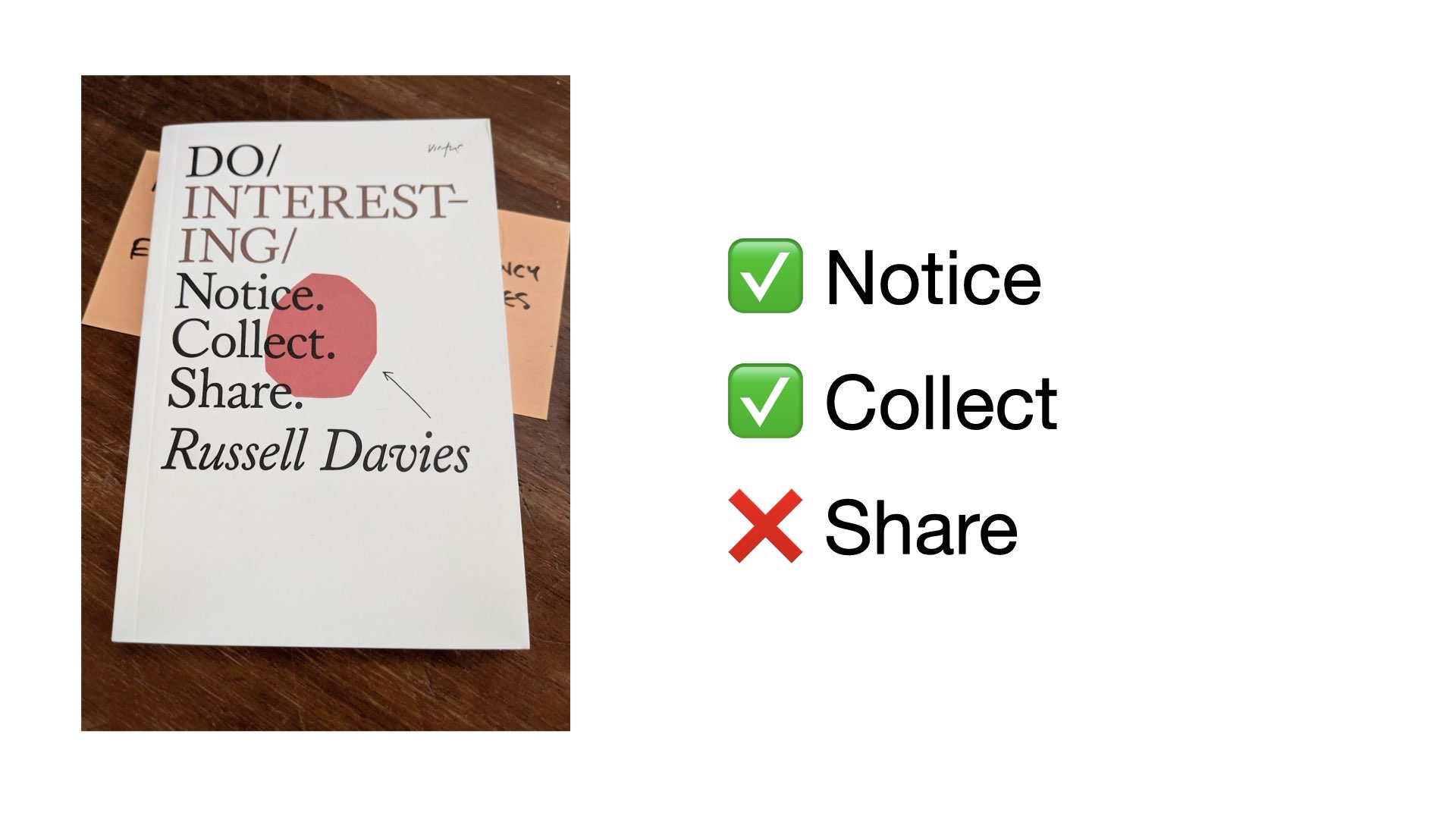
  <img src="/images/do-interesting-01.jpg" alt="Photo of the Do Interesting book next to a list of notice and collect, with ticks for done, and share, with a cross for not done" style="outline: 1px solid var(--paynes-grey-tint-4)" loading="lazy" />
</div>

<p><a href="https://russelldavies.typepad.com/">Russell Davies</a> recently published a book called <a href="https://thedobook.co/products/do-interesting-notice-collect-share">“Do Interesting”</a> and it’s very good. It’s little and has a wonderful tone to it. It struck a chord and I have found it to be very encouraging.</p>

<p>I also decided to take the “share” part of it seriously, and so did a presentation about things I notice and collect, but haven’t shared. Possibly from fear that the things I notice and collect make me a dullard…</p>

<h3 id="2-that-photo-again">2: That photo again</h3>

<div class="full-width">
  <img src="/images/do-interesting-02.jpg" alt="Photo of canang sari on a tiled floor" style="outline: 1px solid var(--paynes-grey-tint-4)" loading="lazy" />
</div>

<p><a href="/posts/2019/06/22/shallow-planes/">In another post</a> I’ve mentioned just how deeply chuffed I am with the photo above. I took it in Bali, of some <a href="https://en.wikipedia.org/wiki/Canang_sari">canang sari</a> outside a shopfront. Nobody liked it on Instagram but I don’t care. I think there’s something in that composition, where everything just magically balances.</p>

<h3 id="3-de-kooning-krasner-pollock">3: <a href="https://en.wikipedia.org/wiki/Willem_de_Kooning">de Kooning</a>, <a href="https://en.wikipedia.org/wiki/Lee_Krasner">Krasner</a>, <a href="https://en.wikipedia.org/wiki/Jackson_Pollock">Pollock</a></h3>

<div class="full-width">
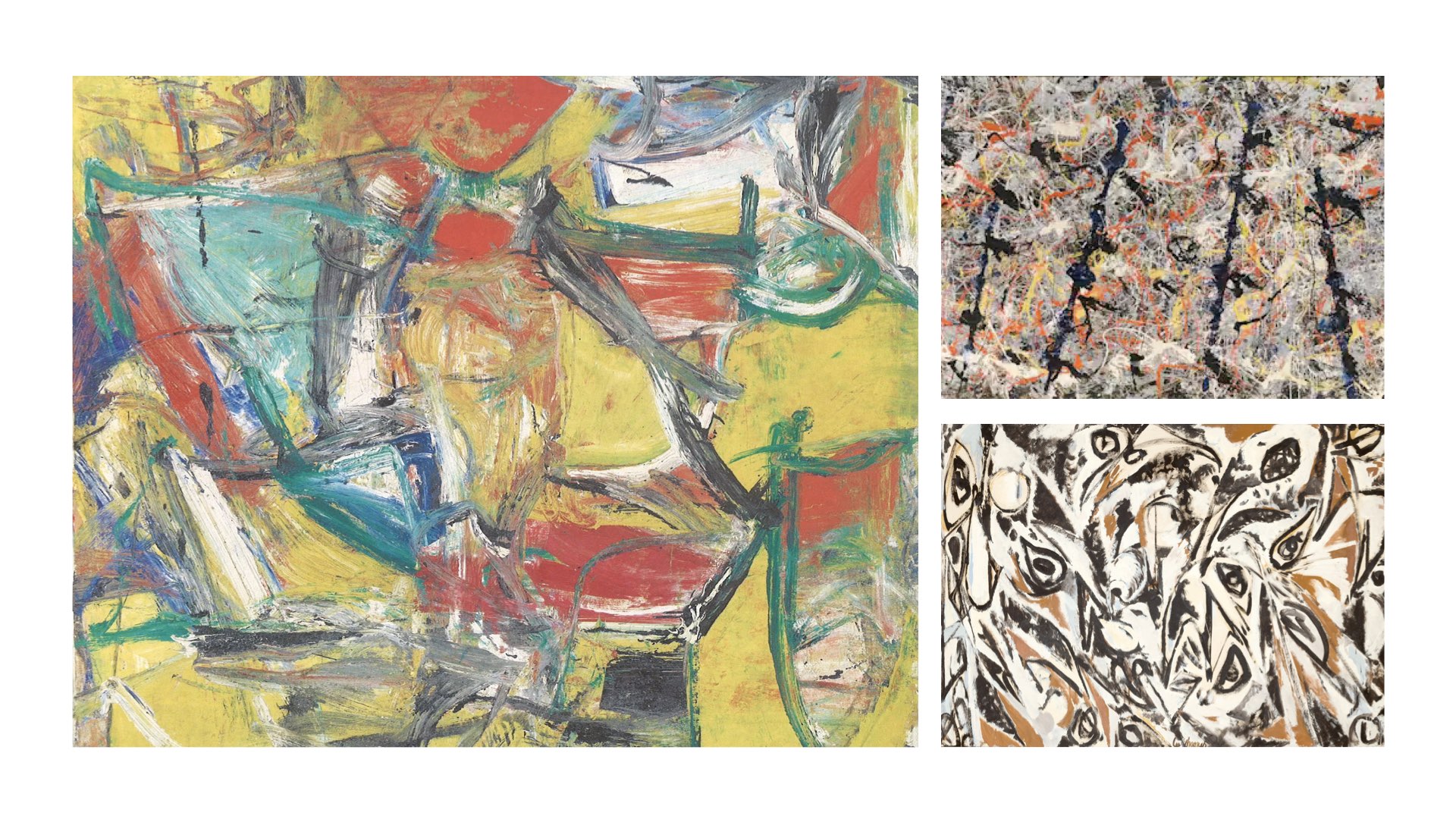
  <img src="/images/do-interesting-03.jpg" alt="Details of paintings by Willem de Kooing, Lee Krasner, and Jackson Pollock" style="outline: 1px solid var(--paynes-grey-tint-4)" loading="lazy" />
</div>

<p>Something I’ve noticed is that I have always been fascinated by painting that:</p>

<ul>
  <li>is figuratively suggestive of forms</li>
  <li>occupies a shallow visual field</li>
</ul>

<h3 id="4-collecting-shallow-planes">4: Collecting shallow planes</h3>

<div class="full-width">
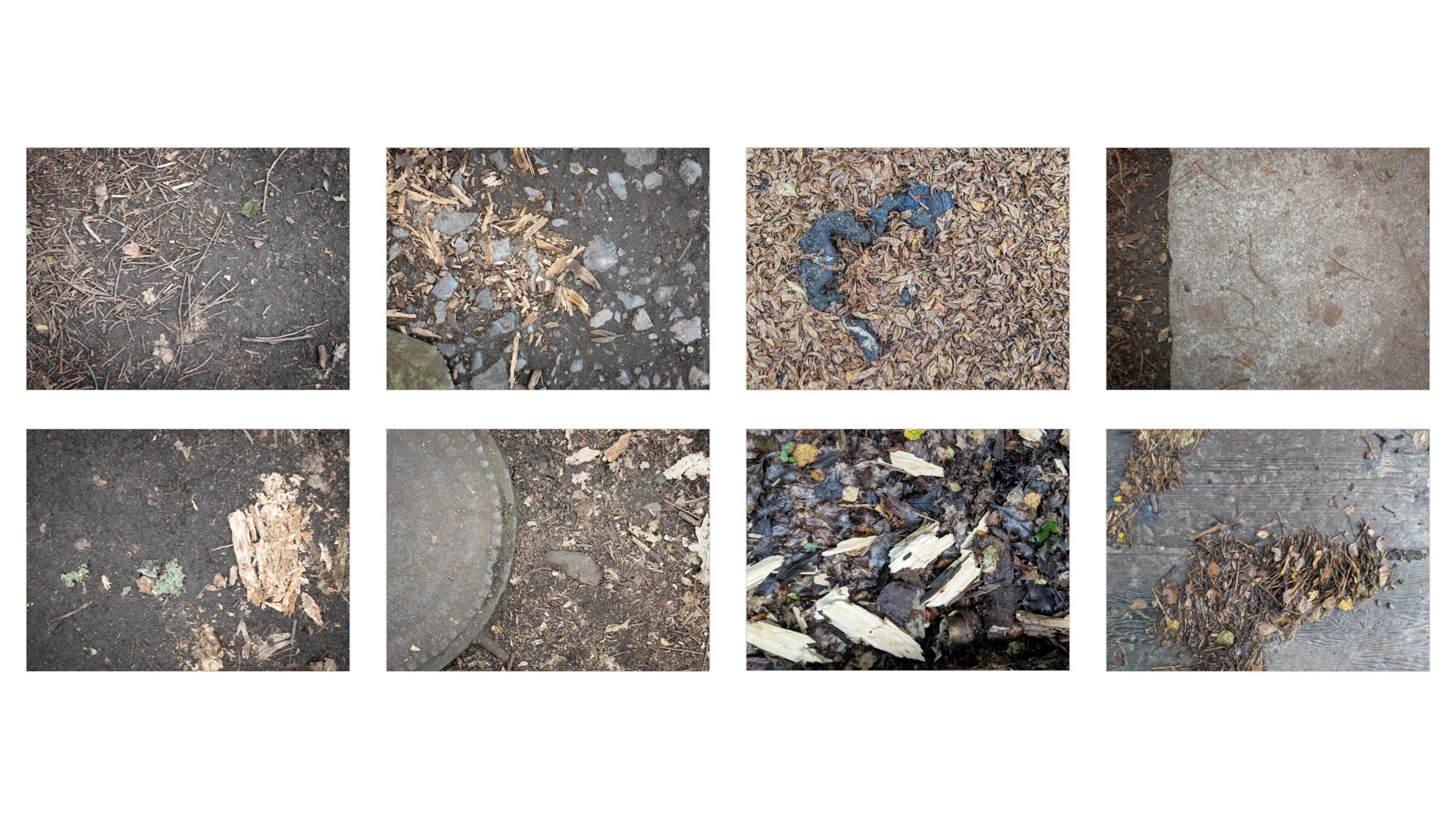
  <img src="/images/do-interesting-04.jpg" alt="Group of 8 photos, all of the ground, taken at 90 degrees" style="outline: 1px solid var(--paynes-grey-tint-4)" loading="lazy" />
</div>

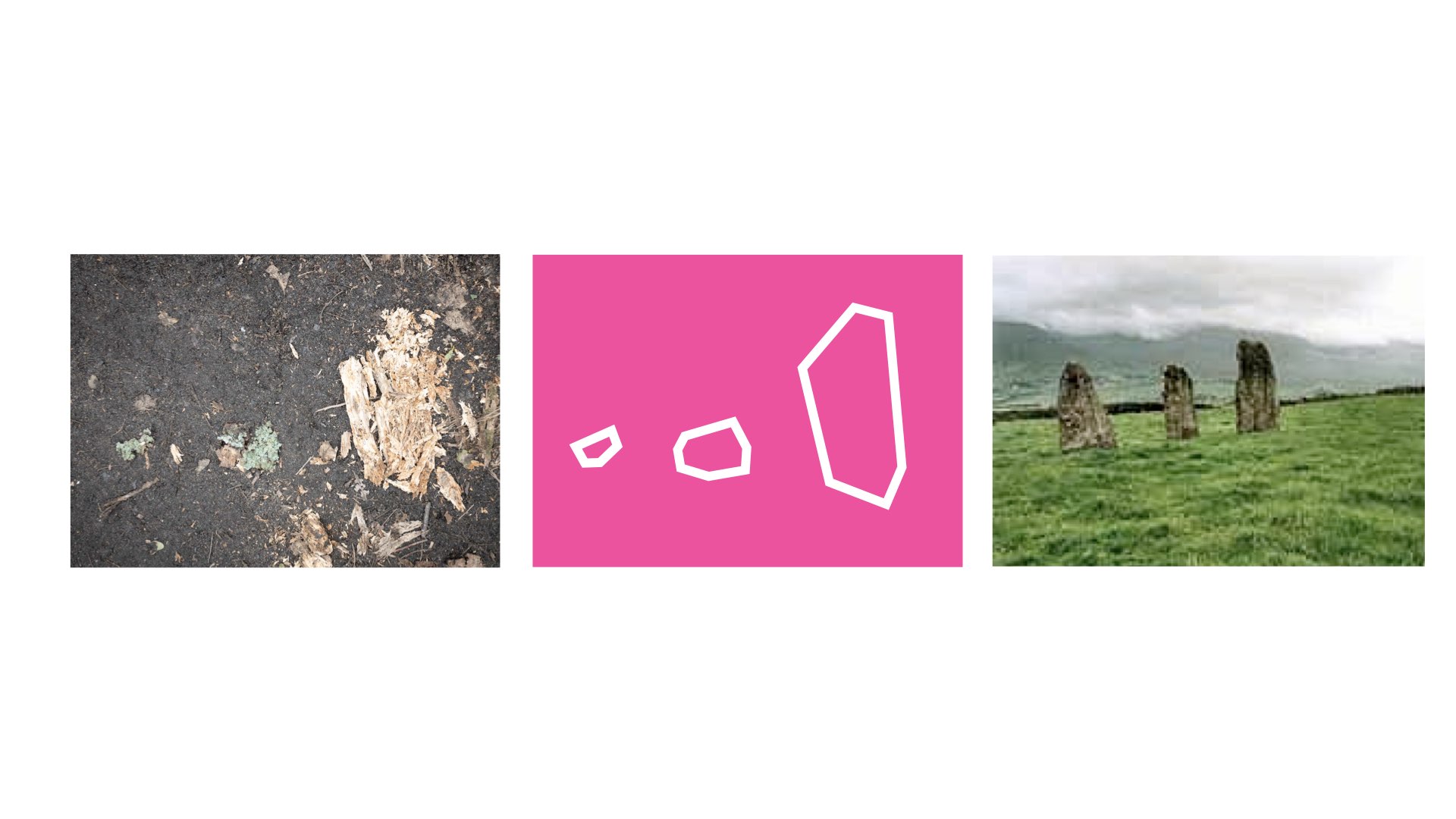
<p>So. It seems I have a tendency to collect things I see that resonate in a similar way. Photos taken, invariably at 90° to the ground, of found compositions.</p>

<h3 id="5-finding-pictures-on-the-ground">5: Finding pictures on the ground</h3>

<div class="full-width">
  <img src="/images/do-interesting-05.jpg" alt="Diagram picking out the resemblance of shards of wood and moss on the ground to a line of 3 standing stones" style="outline: 1px solid var(--paynes-grey-tint-4)" loading="lazy" />
</div>

<p>I think I noticed the moss and wood on the ground because it figuratively suggested something to me, and had a nice balance of composition. So I collected it.</p>

<h3 id="6-hyong-keun-newman">6: <a href="https://en.wikipedia.org/wiki/Yun_Hyong-keun">Hyong-keun</a>, <a href="https://en.wikipedia.org/wiki/Barnett_Newman">Newman</a></h3>

<div class="full-width">
  <img src="/images/do-interesting-06.jpg" alt="A painting by Yun Hyong-keun alongside a print by Barnett Newman, both abstract and rectilinear" style="outline: 1px solid var(--paynes-grey-tint-4)" loading="lazy" />
</div>

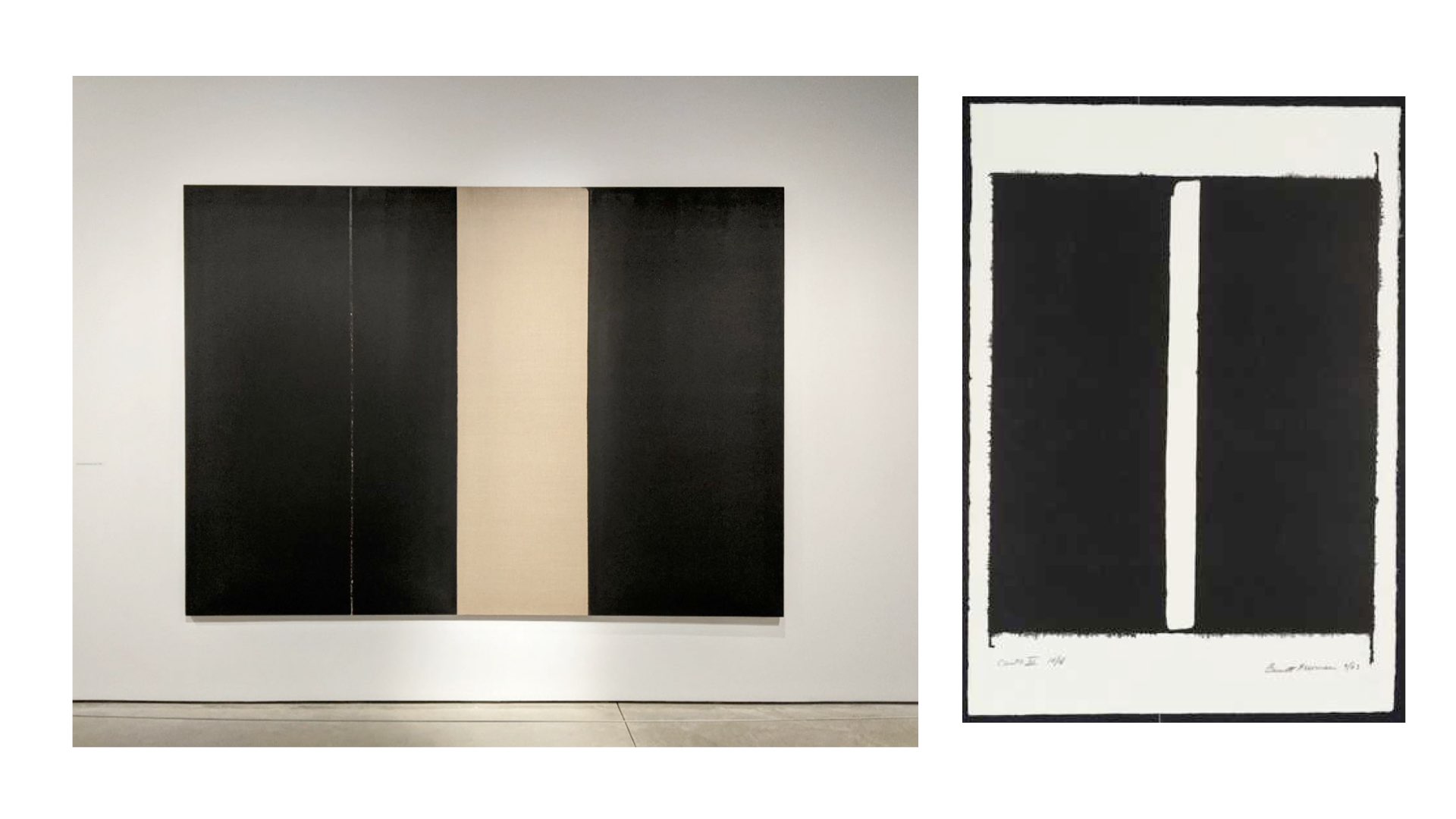
<p>I also have a soft spot for straight up “it’s just some rectangles!” abstraction.</p>

<h3 id="7-walking-the-dog">7: Walking the dog</h3>

<div class="full-width">
  <img src="/images/do-interesting-07.jpg" alt="Two photos showing my dog on a wooden walkway in the woods" style="outline: 1px solid var(--paynes-grey-tint-4)" loading="lazy" />
</div>

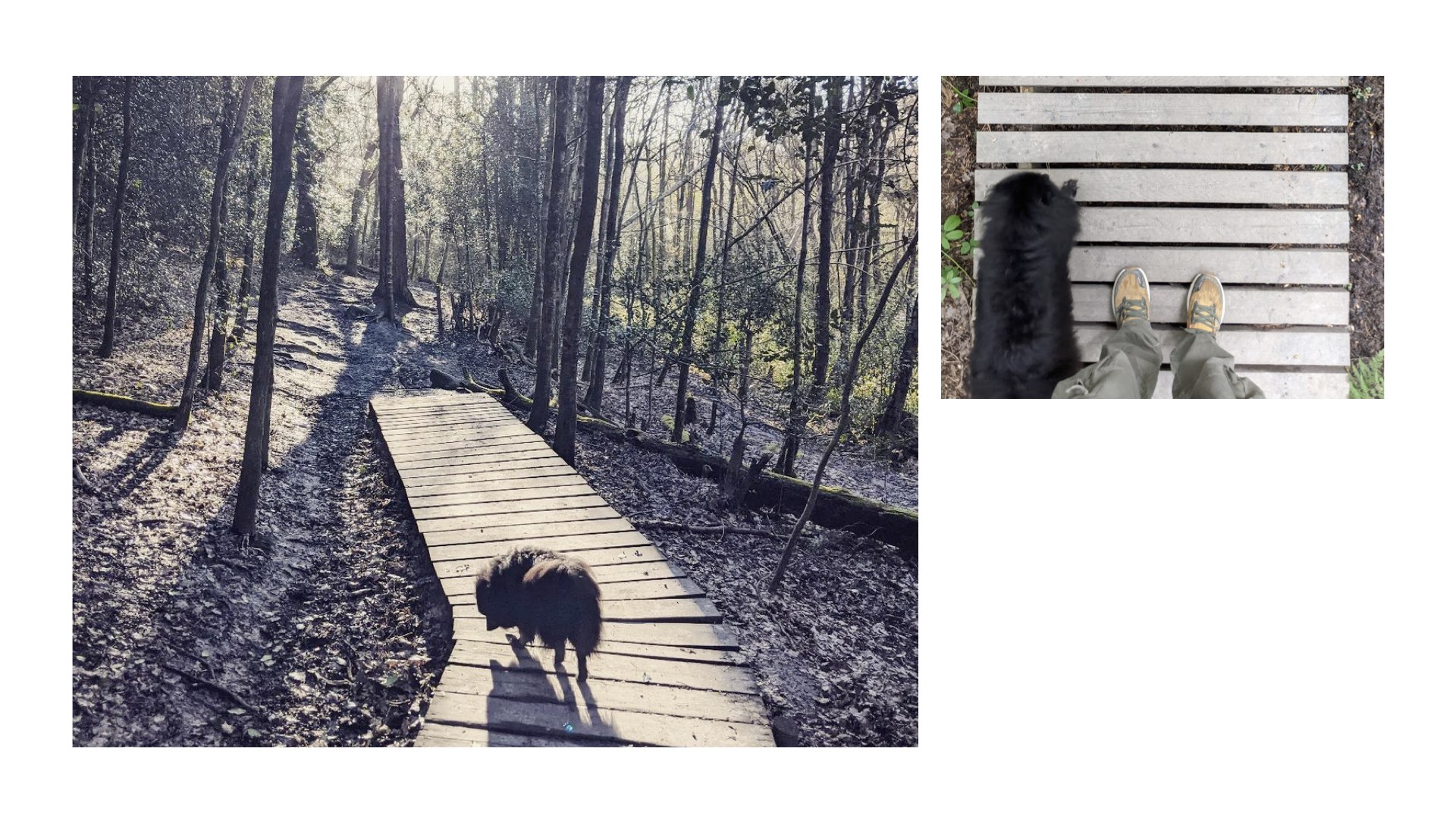
<p>Now we live in Sussex I walk the dog in the woods almost every day. In these woods are a lot of wooden walkways and little bridge type things, because it gets super muddy.</p>

<h3 id="8-collecting-walkways">8: Collecting walkways</h3>

<div class="full-width">
  <img src="/images/do-interesting-08.jpg" alt="Group of 10 photos, all of wooden walkways, taken at 90 degrees" style="outline: 1px solid var(--paynes-grey-tint-4)" loading="lazy" />
</div>

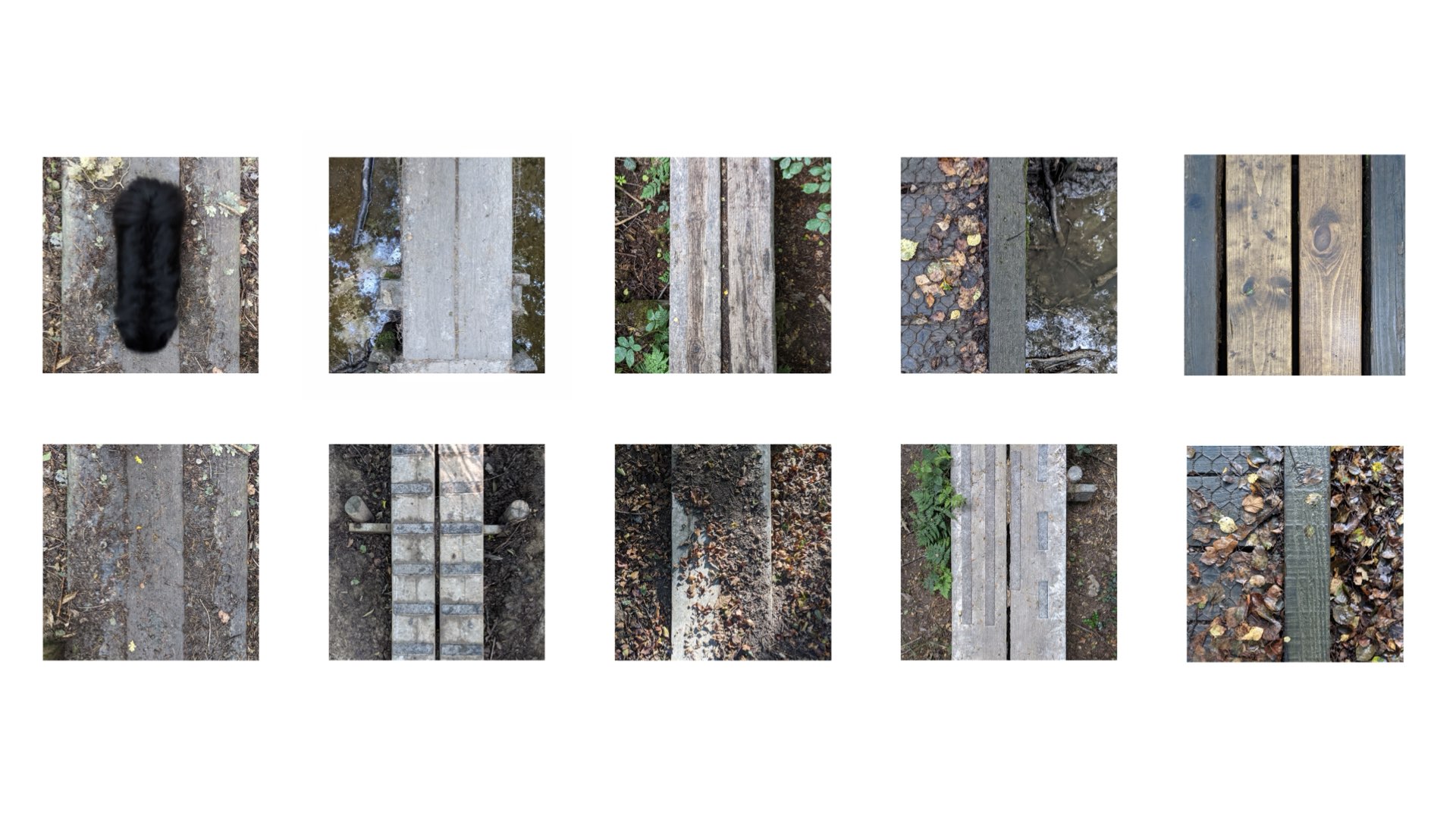
<p>Obviously my brain got hold of these walkways and decided that at 90° they were basically abstract paintings. And so I started collecting them.</p>

<h3 id="9-noticed-collected-shared">9: Noticed, collected, shared</h3>

<div class="full-width">
  <img src="/images/do-interesting-09.jpg" alt="A list of notice, collect, and share, all with ticks for done" style="outline: 1px solid var(--paynes-grey-tint-4)" loading="lazy" />
</div>

<p>I have:</p>

<ul>
  <li>noticed that I find interesting images on the ground</li>
  <li>collected a bunch of them as photos</li>
  <li>shared them in a talk (and now a post)</li>
</ul>

<p>Thanks!</p>

<hr />

<p>Phew. 4 minutes to spare. Luckily Keynote does a decent slides-to-image and <code>loading="lazy"</code> is a thing.</p>]]></content><author><name>Mat Johnson</name></author><category term="posts" /><summary type="html"><![CDATA[Something we do in our little design team is “development time”. It goes in the calendar every other Monday for 2 hours. It’s supposed to be time that people can devote to their own projects. It might be:]]></summary></entry><entry><title type="html">On meeting up: redux</title><link href="https://demotive.com/posts/2023/09/29/design-squad/" rel="alternate" type="text/html" title="On meeting up: redux" /><published>2023-09-29T00:00:00+00:00</published><updated>2023-09-29T00:00:00+00:00</updated><id>https://demotive.com/posts/2023/09/29/design-squad</id><content type="html" xml:base="https://demotive.com/posts/2023/09/29/design-squad/"><![CDATA[<p>In the last post <a href="/posts/2023/07/25/on-meeting-up/">on meeting up</a>, I mentioned subtly that I’ve become one of the design leads for our team. I honestly never thought I’d be leading anyone anywhere in a million years. There’s so much to think about and maybe discuss, all that stuff about line management versus mentorship and the dangers of attempting to do both.</p>

<p>But. As this is the sequel to the second post in a set of two I wanted to get some more stuff down about meeting up in person, but through the lens of trying to lead a small group of designers.</p>

<p>In timeline order this means the posts look like this:</p>

<ul>
  <li><a href="/posts/2023/06/21/on-remoting/">on remoting</a></li>
  <li><a href="/posts/2023/07/25/on-meeting-up/">on meeting up</a></li>
  <li>on meeting up redux (this one)</li>
</ul>

<hr />

<h2 id="design-days">Design days</h2>

<p>As a small sub-group of the overall product team, we have a few regular remote sessions that we use to keep up to date, crit work and so on.</p>

<p>Importantly we’ve also instituted semi-regular “design days“ where we get together in person. These days are structured in a way that combines business with business-related-pleasure:</p>

<ol>
  <li>in the morning a team exercise - a retro, healthcheck, crit, or similar</li>
  <li>in the afternoon an activity related to design, possibly linked to a current theme in our work</li>
</ol>

<p>So far we’ve:</p>

<ul>
  <li>done a retrospective of our ways of working, followed by a watch and a crit of <a href="https://www.hustwit.com/rams">Rams</a></li>
  <li>done a much more informal retro, then a visit to the <a href="https://www.postalmuseum.org/">Postal Museum</a> to nerd out on <a href="https://www.postalmuseum.org/visit-us/what-to-expect/exhibitions/sorting-britain/">postcodes.</a></li>
  <li>done a healthcheck, then onto <a href="https://wellcomecollection.org/exhibitions/Yv95yBAAAILuCNv6">In Plain Sight</a> at the <a href="https://wellcomecollection.org/">Wellcome Collection</a></li>
  <li>skipped the ceremony and went straight to see the <a href="https://www.navigatingthesystem.co.uk/">Navigating the System</a> exhibition at the <a href="https://www.ucl.ac.uk/urban-lab/about/ucl-east/ucl-urban-room">UCL Urban Room</a></li>
  <li>skipped the ceremony <em>again</em> and went straight to see the <a href="https://www.sciencemuseum.org.uk/see-and-do/injecting-hope">COVID exhibition</a> at the <a href="https://www.sciencemuseum.org.uk/">Science Museum</a> (that was a weird one for us)</li>
  <li>done a dry run and crit of an upcoming whole-team ideation session, then got the Thames Clipper to the new hang at the <a href="https://www.npg.org.uk/">National Portrait Gallery</a></li>
</ul>

<h3 id="into-the-office">Into the office…</h3>

<p>We’ve toyed with the idea of doing the work portion in a different space like a WeWork or something, but so far we’ve always ended up in the Canary Wharf office (London is the local office for most of us, and the most desired meetup location for some of us).</p>

<p>During the lockdown(s), our existing office in Elephant and Castle was shuttered and the new one in Canary Wharf started up. I think this has accentuated feelings of strangeness. We’re not going back to a place we knew before and are comfortable with, we’re now visiting somewhere new and alien. I still can’t find the toilets or the kitchens, it’s somehow near impossible to book a room - all that sort of thing.</p>

<p>As weird as it often is, I still think it’s the “healthy” thing to do. We get to smile and nod at the odd person. It’s definitely got good views. Perhaps we will ever so gradually start feeling like this new office is <em>our</em> office.</p>

<h3 id="and-then-straight-out-again">…and then straight out again</h3>

<p>What I personally think is far more important for us is to then get straight back out of the office and go do something else. There’s usually a link to our work, but I don’t think that should be a mandate.</p>

<p>We’re luckily small enough to be able to get lunch, do a thing, then get more grub and chat into the evening if we want to, without it being a huge logistical operation.</p>

<p>It’s good for us as a group to do activities that aren’t always just our day to day work. It helps us remain designers. Visting things and discussing them, finding interest and inspiration and sparking off each other.</p>

<h2 id="end-thoughts">End thoughts</h2>

<p>It would be remiss not to acknowledge the influence of <a href="https://www.benterrett.com/">Ben Terrett</a> on this aspect of how I’m trying to “lead”. The GDS weekly design meeting was something I actively looked forward to, a combination of simply updating each other on what we’d been doing, guest speakers, little outings, all handled with a feeling of good humoured chaos.</p>

<p>I really want to attain a similar vibe in our little team. That feeling of being collegiate with some like minded souls. A spirit of friendship (or at least amiable tolerance) and shared interest. Not just delivering work, but a tight knit group of people.</p>

<p>I believe that being a tight team leads to better output. We’re more used to each other as people, more at ease with each other, and thus more open to constructive critiques, questions etc. We’re good at pairing or teaming up on a problem. The meetup days are an integral part of the oil keeping the machine ticking along smoothly.</p>

<p>I think these meetup days are precious, as they bring a special bit of the old pre-pandemic world back into the new. To be clear though, I don’t hanker <em>at all</em> for the old days in the office. At the moment I think we’re feeling our way towards a new balance. What we’ve got right now is an opportunity to explore what really works for each of us while remaining a solid and productive team.</p>]]></content><author><name>Mat Johnson</name></author><category term="posts" /><summary type="html"><![CDATA[In the last post on meeting up, I mentioned subtly that I’ve become one of the design leads for our team. I honestly never thought I’d be leading anyone anywhere in a million years. There’s so much to think about and maybe discuss, all that stuff about line management versus mentorship and the dangers of attempting to do both.]]></summary></entry><entry><title type="html">On meeting up</title><link href="https://demotive.com/posts/2023/07/25/on-meeting-up/" rel="alternate" type="text/html" title="On meeting up" /><published>2023-07-25T00:00:00+00:00</published><updated>2023-07-25T00:00:00+00:00</updated><id>https://demotive.com/posts/2023/07/25/on-meeting-up</id><content type="html" xml:base="https://demotive.com/posts/2023/07/25/on-meeting-up/"><![CDATA[<p>A companion piece to <a href="/posts/2023/06/21/on-remoting/">on remoting.</a> I thought I’d do it coming fresh from some meets all very close together. Then as usual the post took <em>ages</em> to pull together. I don’t know how people bang these things out so fast.</p>

<hr />

<p>Everything changed in early 2020. All our office locations shut down with immediate effect, for “up to 12 weeks”.</p>

<p>We never went back.</p>

<p>Our office in Elephant and Castle was shuttered permanently and we’ve been remote ever since.</p>

<p>The org has a new office in Canary Wharf, but so far it doesn’t seem to have regained the atmosphere of the old. It’s rare for our team to be in at the same time, and desk booking arrangements mean we’ve no longer got a space to call our own. When I do go into the office, what I often experience is a very quiet sparsely populated environment. People there (including me) are often… on calls.</p>

<p>I’ve been mulling over how things have changed, and what it’s like when we do meet up.</p>

<h2 id="what-was-it-like-before">What was it like before?</h2>

<p>The team has always been split over several locations: Exeter; Leeds; London; Southampton.</p>

<p>We’d do standups with people in each office clustered around those big MS Surface tv things (when we could get them to actually work), and were quite used to doing that sort of “remote across multiple office sites” sort of thing.</p>

<p>We would always get together in person as a whole team for sprint ceremonies, and often we’d also make an effort to do UR analysis in person as a whole team exercise.</p>

<div>
  <img src="/images/on-meeting-up-then.png" alt="" loading="lazy" />
</div>

<p>In effect the pattern of work was that most of us would be in a small office based team day-to-day, then regularly get together with the whole team.</p>

<h2 id="what-is-it-like-now">What is it like now?</h2>

<p>Nowadays the whole team gets together roughly once a month (every other sprint I think) in one of the three “base” locations that our members now belong to: Exeter, Leeds, or London. This might be in one of the offices, or it might be in a booked venue. Ironically enough, booking space in the org can be the tougher option.</p>

<p>We do the usuals:</p>

<ul>
  <li>a broadcast show and tell</li>
  <li>an internal show and tell for all the juicy stuff</li>
  <li>sometimes ceremonies like retro or planning</li>
  <li>sometimes team scale things like healthchecks</li>
</ul>

<p>There’s also an effort to organise low pressure social stuff at the end of the day.</p>

<p>Without fixed spaces, it’s not quite as easy to organise and not everyone can make it every time, especially as the team has grown - sparked by the need to deliver harder and faster during the pandemic.</p>

<div>
  <img src="/images/on-meeting-up-now.png" alt="" loading="lazy" />
</div>

<p>I think the big difference here is that we go from individuals working remotely to a large group in one fell swoop.</p>

<h2 id="on-reflection">On reflection</h2>

<p>I used to sit with a handful of team mates during my work day in the office. This gave me confidence in the wider group — that thing where you know some people pretty well already, so you’re not immediately stymied by meeting <em>everyone.</em></p>

<p>Group events can be hard. I’ve always struggled with similar things like conferences and meetups, sometimes literally sneaking off. In the aftermath of the pandemic I live a more isolated life, and the abrupt jump in scale between solitude and multitude can be difficult.</p>

<p>But while a meet up can sometimes be tough, there’s all the positives:</p>

<ul>
  <li>an opportunity to resurrect those little rituals — bring the bike into town, have a nice coffee somewhere</li>
  <li>seeing people I’ve known for <em>years</em> now — products don’t move at the speed of light in the NHS, and there’s those of us that have committed to a longer haul than we might have initially expected</li>
  <li>getting up and doing things in front of people, while stressful, is healthy (er… I think)</li>
  <li>just the quiet physical feeling of being one bit of a larger thing</li>
</ul>

<p>The missing piece of the puzzle has been that smaller, comfortable group, where the contrast between being performative (presenting, running workshops, etc) and just oneself is less extreme. Luckily over time I’ve ended up being involved in leading our team’s small design and content discipline and for me this group helps a lot. At some point I plan to write more about “leading”, LOL.</p>

<p>Finally, there’s the simple realisation that adjusting to changes of this magnitude can really, really take time.</p>]]></content><author><name>Mat Johnson</name></author><category term="posts" /><summary type="html"><![CDATA[A companion piece to on remoting. I thought I’d do it coming fresh from some meets all very close together. Then as usual the post took ages to pull together. I don’t know how people bang these things out so fast.]]></summary></entry><entry><title type="html">On remoting</title><link href="https://demotive.com/posts/2023/06/21/on-remoting/" rel="alternate" type="text/html" title="On remoting" /><published>2023-06-21T00:00:00+00:00</published><updated>2023-06-21T00:00:00+00:00</updated><id>https://demotive.com/posts/2023/06/21/on-remoting</id><content type="html" xml:base="https://demotive.com/posts/2023/06/21/on-remoting/"><![CDATA[<p>A companion piece to <a href="/posts/2023/07/25/on-meeting-up/">on meeting up.</a></p>

<hr />

<p>Everything changed in early 2020. All our office locations shut down with immediate effect, for “up to 12 weeks”.</p>

<p>We never went back.</p>

<p>Our office in Elephant and Castle was shuttered permanently and we’ve been remote ever since.</p>

<p>The org has a new office in Canary Wharf, but so far it doesn’t seem to have regained the atmosphere of the old. It’s rare for our team to be in at the same time, and desk booking arrangements mean we’ve no longer got a space to call our own. When I do go into the office, what I often experience is a very quiet sparsely populated environment. People there (including me) are often… on calls.</p>

<p>I’ve been mulling over how things have changed, and what it’s like to be a remote worker.</p>

<h2 id="whats-been-lost">What’s been lost?</h2>

<h3 id="rituals">Rituals</h3>

<p>I miss the little rituals and structure of going to the office:</p>

<ul>
  <li>the bike ride to work</li>
  <li>the crappy showers</li>
  <li>the morning hellos</li>
  <li>the coffee from the shipping container outside UAL</li>
  <li>the post-it based standups</li>
  <li>the ease of “can I borrow you for a minute just to look at this?”</li>
  <li>the bike ride home from work</li>
</ul>

<h3 id="spaces">Spaces</h3>

<p>The presence of work on walls in our team area was easy to underestimate at the time in terms of how well it could communicate.</p>

<p>Being able to go through things that were already to hand with visitors, stakeholders, team members, or interested passers-by was often far simpler than setting up specific presentations and demos.</p>

<p>I feel a sense of loss in no longer having a shared physical space. But I think that sense of loss is inextricably linked to the fact I’ve been entirely in these sorts of environments for decades — from college into work, right up until the pandemic. I absolutely don’t believe the work a team does <em>must</em> be done in person in a shared space, it’s more I’m feeling the effect of the abrupt and fundamental change.</p>

<p>There are those of us lucky enough to have the space to create <em>something</em> of this environment at home. But there’s a difference between lone spaces and shared ones — as a kid I built <em>hides</em> for myself and <em>bases</em> with friends.</p>

<h3 id="insight">Insight</h3>

<p>A couple of years of observing and conducting research in Teams is not fun for anyone. We lost a lot of the sharp insights into design and interaction that come from close observation in person, whether that’s a lab or <a href="/posts/2022/12/21/id-clangers/">popping up unannounced.</a></p>

<p>The times we’ve managed to do in-person research in the recent past have been a painful reminder of the sheer loss of fidelity of doing this sort of thing only remotely. I am personally really glad that doing in-person UR is starting to make a comeback.</p>

<h2 id="whats-been-gained">What’s been gained?</h2>

<h3 id="documentation">Documentation</h3>

<p>From post-its and print outs on walls to Mural and Jira. The things that were very informal have perhaps become much more formal (and maybe more “industry standard” I guess).</p>

<p>I’ve got mixed feelings about the sheer volume of output, and the hoarding instinct that goes with it. The signal is there, but there’s often a <em>lot</em> of noise to go with it.</p>

<p>Conversely I’ve run afoul of not documenting well enough in the past (forgetting decisions or specific iterations etc), and it’s not doing me any harm to write stuff up a bit more and a bit better.</p>

<h3 id="sharing-and-collaboration">Sharing and collaboration</h3>

<p>A “wall of work” in an office space is not very portable. It requires people to come to you.</p>

<p>Tools like Mural and Miro have really come into their own in creating an alternative. I’m not sure these tools are <em>better</em> as they come with their own intrinsic problems of access.</p>

<p>However it’s true to say sharing often and widely with in a distributed manner has become a habit surprisingly quickly. Remote crit sessions or broadcasting a request for feedback very widely — often using a limited window of time rather than organising a big… meeting.</p>

<h3 id="meetings">Meetings</h3>

<p>Definitely gained some meetings. Meetings all the time. Working out whether to blur your background or not. Camera on, camera off? Being stuck on mute. Meetings in Teams, meetings in Zoom, meetings in Meet, it goes on.</p>

<p>A lot of the group interaction that seemingly came for free with office space now needs to be quite deliberately arranged. Juggling calendars is definitely one of the most annoying things I do now.</p>

<h2 id="finally">Finally</h2>

<p>As we’ve always been split over sites, we were <em>kind of</em> “remote first” already. It’s probably fair to say the differences in the way we work as a team are haven’t changed as much as the way we communicate <em>outside</em> the team in the wider org.</p>

<p>What’s been hardest for me is also the area of most possibility. As a largely remote worker, there are opportunities to assess how your work life and personal life intersect — or don’t.</p>

<p>There’s a danger that the two become inextricably blurred to the point when downtime becomes impossible, and having done some work directly related to the pandemic I don’t think I (or many others in the team) really want that to be the norm.</p>

<p>There’s also a truism I subscribe to that ideas don’t always come when you’re plugging away at the computer. It can be those downtime moments when inspiration finally strikes: when I’m walking the dog; when I used to ride to work; or waking up in the middle of the bloody night. If you’re not able to separate yourself in the same way, are you blocking these moments?</p>

<p>So while it’s entirely possible to sleep in, get up at the last second and do the whole day in my pyjamas, I’ve tried to build new rituals:</p>

<ul>
  <li>walk the dog before work</li>
  <li>a nice shower</li>
  <li>Slack and Teams morning hellos</li>
  <li>make a swish coffee at home</li>
  <li>standups on Teams</li>
  <li>pinging people and chatting a lot on Slack</li>
  <li>trying hard to <em>have a lunch break</em></li>
  <li>doing <em>something</em> to try to close the day off</li>
</ul>

<p>In conclusion, being largely remote has, ever so slowly, knocked me for six. I think I can admit that it’s not possible to rewire yourself overnight.</p>

<p>It’s taking <em>years</em> to get used to what a day is like, and it could be a few more. It’s not the new ways of working that cause the pain. What hurts is simply <em>missing</em> people.</p>

<p>So in that vein stay tuned for a companion piece about… meeting up.</p>]]></content><author><name>Mat Johnson</name></author><category term="posts" /><summary type="html"><![CDATA[A companion piece to on meeting up.]]></summary></entry><entry><title type="html">Coverack</title><link href="https://demotive.com/pictoral/2023/06/16/coverack/" rel="alternate" type="text/html" title="Coverack" /><published>2023-06-16T00:00:00+00:00</published><updated>2023-06-16T00:00:00+00:00</updated><id>https://demotive.com/pictoral/2023/06/16/coverack</id><content type="html" xml:base="https://demotive.com/pictoral/2023/06/16/coverack/"><![CDATA[<p>I’ve twice tried this “one sketch a day” thing and it kills me. If I try to dash off quick sketches it’s more often than not simply depressing.</p>

<p>On some R&amp;R in Cornwall, I decided instead to sketch the view over a few days. Just taking it easy, a few marks on paper every now and again. Felt better.</p>

<div class="full-width">
  <figure>
    <img src="/images/coverack-pencil.jpg" alt="Pencil drawing of Chynhalls Point" loading="lazy" />
    <figcaption>
      Chynhalls Point
    </figcaption>
  </figure>
</div>]]></content><author><name>Mat Johnson</name></author><category term="pictoral" /><summary type="html"><![CDATA[I’ve twice tried this “one sketch a day” thing and it kills me. If I try to dash off quick sketches it’s more often than not simply depressing.]]></summary></entry><entry><title type="html">Death certification</title><link href="https://demotive.com/portfolio/2023/06/09/medical-examiner/" rel="alternate" type="text/html" title="Death certification" /><published>2023-06-09T00:00:00+00:00</published><updated>2023-06-09T00:00:00+00:00</updated><id>https://demotive.com/portfolio/2023/06/09/medical-examiner</id><content type="html" xml:base="https://demotive.com/portfolio/2023/06/09/medical-examiner/"><![CDATA[<h2 id="the-brief">The brief</h2>

<p>In May 2016 the Department of Health published <a href="https://www.gov.uk/government/publications/changes-to-the-death-certification-process/an-overview-of-the-death-certification-reforms">guidance on death certification reforms</a>:</p>

<blockquote>
<p>
  Existing arrangements for death certification are confusing, provide inadequate safeguards, and there is no mechanism that allows the NHS to see patterns, take action and learn from them.
</p>
</blockquote>

<p>DH Digital was commissioned to work with the policy unit to discover how digital might assist in the delivery of the new <a href="https://www.gov.uk/government/publications/changes-to-the-death-certification-process/an-overview-of-the-death-certification-reforms#the-reforms">medical examiner</a> role as recommended by the reforms.</p>

<hr />

<h2 id="the-work">The work</h2>

<p>We joined at a point where there were a small number of pilots in progress. The department was trialling the policy as a series of paper forms that embedded the new medical examiner process within existing death certification.</p>

<p>We ran a few work streams to catch up. From the knowledge gained we were then able to build an early prototype to suggest how a digital tool could make the service more efficient and less onerous for those involved in providing it.</p>

<h3 id="the-informant-and-the-system">The informant and the system</h3>

<p>We examined the bureaucratic process of death:</p>

<ul>
  <li>what does someone (the “informant”) have to do in order to notify all relevant organisations of a death?</li>
  <li>within that wider journey where does death certification sit?</li>
</ul>

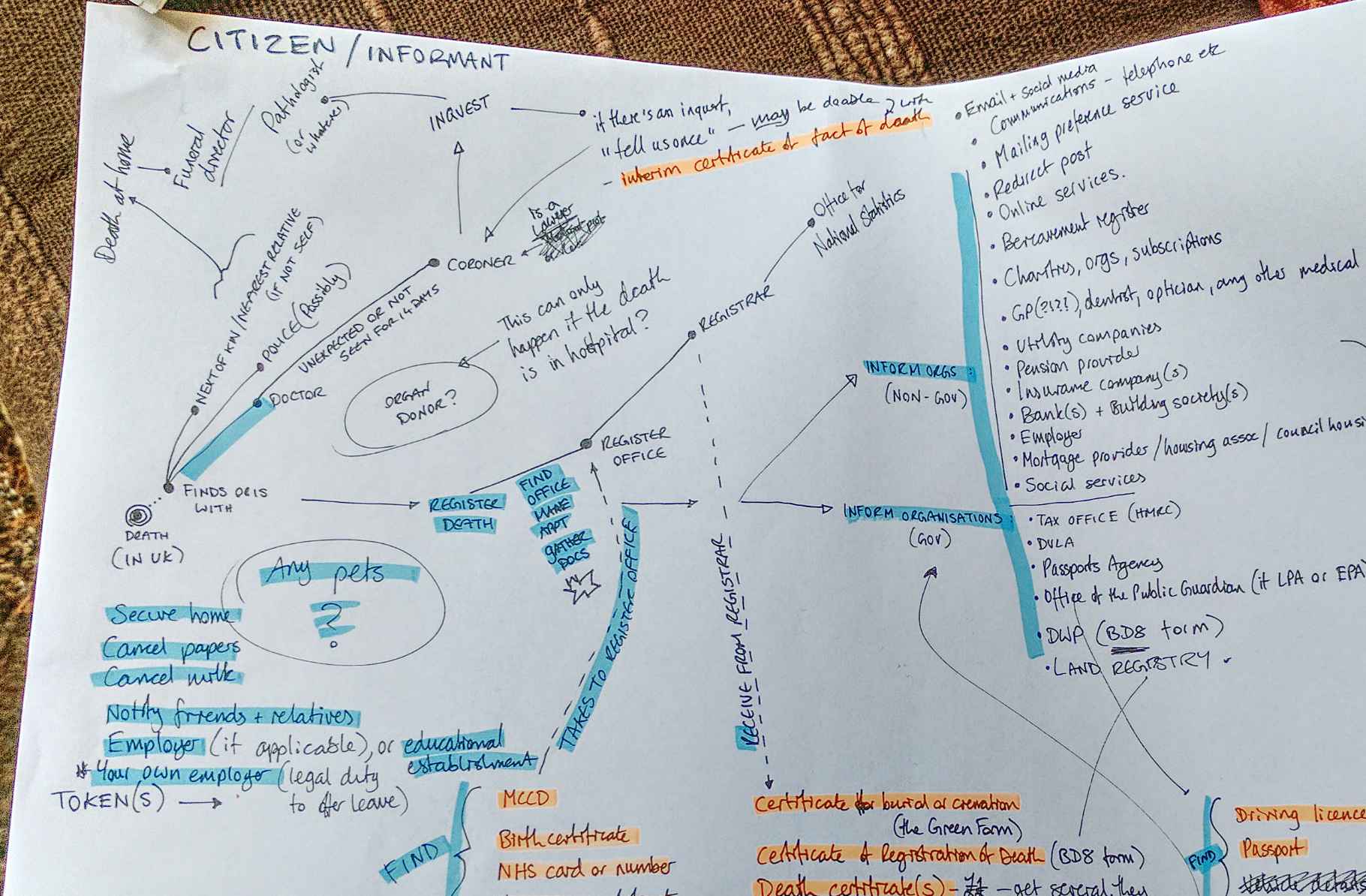
<p>This entailed desk research, observation in secondary care settings, and working with service designers across government departments to identify the full picture.</p>

<div class="full-width">
  <img src="/images/me-map-sketch.jpg" alt="Early paper sketching of the bereavement process" />
</div>

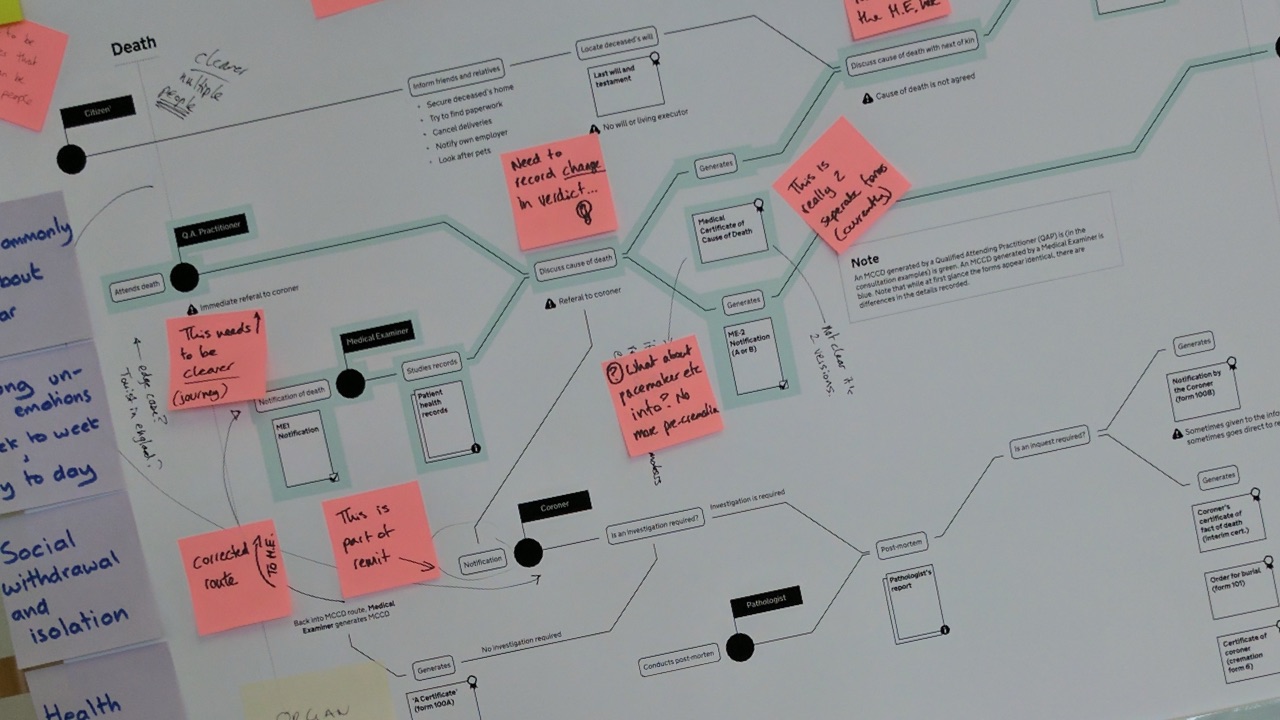
<p>The output was a <a href="https://github.com/department-of-health/bereavement-map/blob/master/bereavement-map.pdf">map of the process</a> which was referred to and evolved during the project. The point of the map was to serve as a context-setting device to properly seat the medical examiner service within the wider journey of the informant (for example the next of kin).</p>

<div class="full-width">
  <img src="/images/death-map.jpg" alt="Bereavement map with post-it comments" />
</div>

<h3 id="learnings-from-pilots">Learnings from pilots</h3>

<p>Sheffield and Gloucester were two areas piloting the policy. We interviewed and observed medical examiners, coroners, and clerical staff to understand variation in context and implementation, such as:</p>

<ul>
  <li>death in a secondary care setting</li>
  <li>death in the community</li>
</ul>

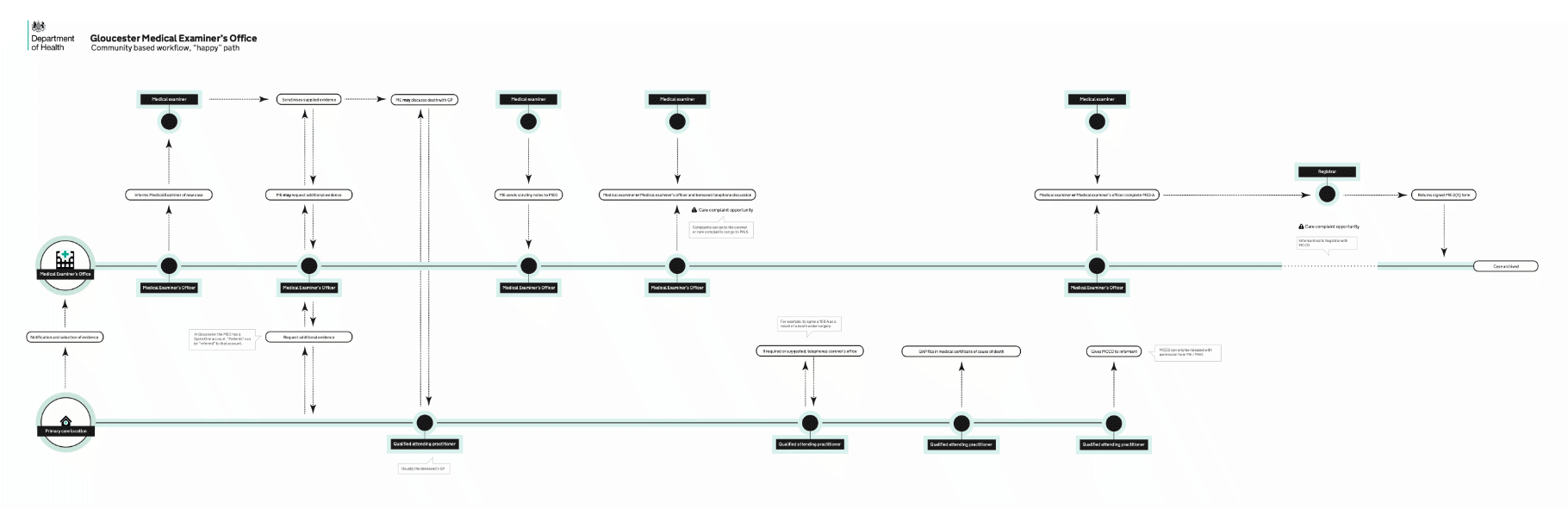
<p>Understanding these <a href="https://github.com/department-of-health/meo-process/tree/master">pilot workflows</a> helped us prototype and promote agnostic tooling, meaning data and policy requirements could be met without imposing a single workflow on multiple service contexts.</p>

<div class="full-width">
  <img src="/images/me-workflow-gloucester.png" alt="Workflow map for a death in the community in Gloucester" />
</div>

<h3 id="the-data-model">The data model</h3>

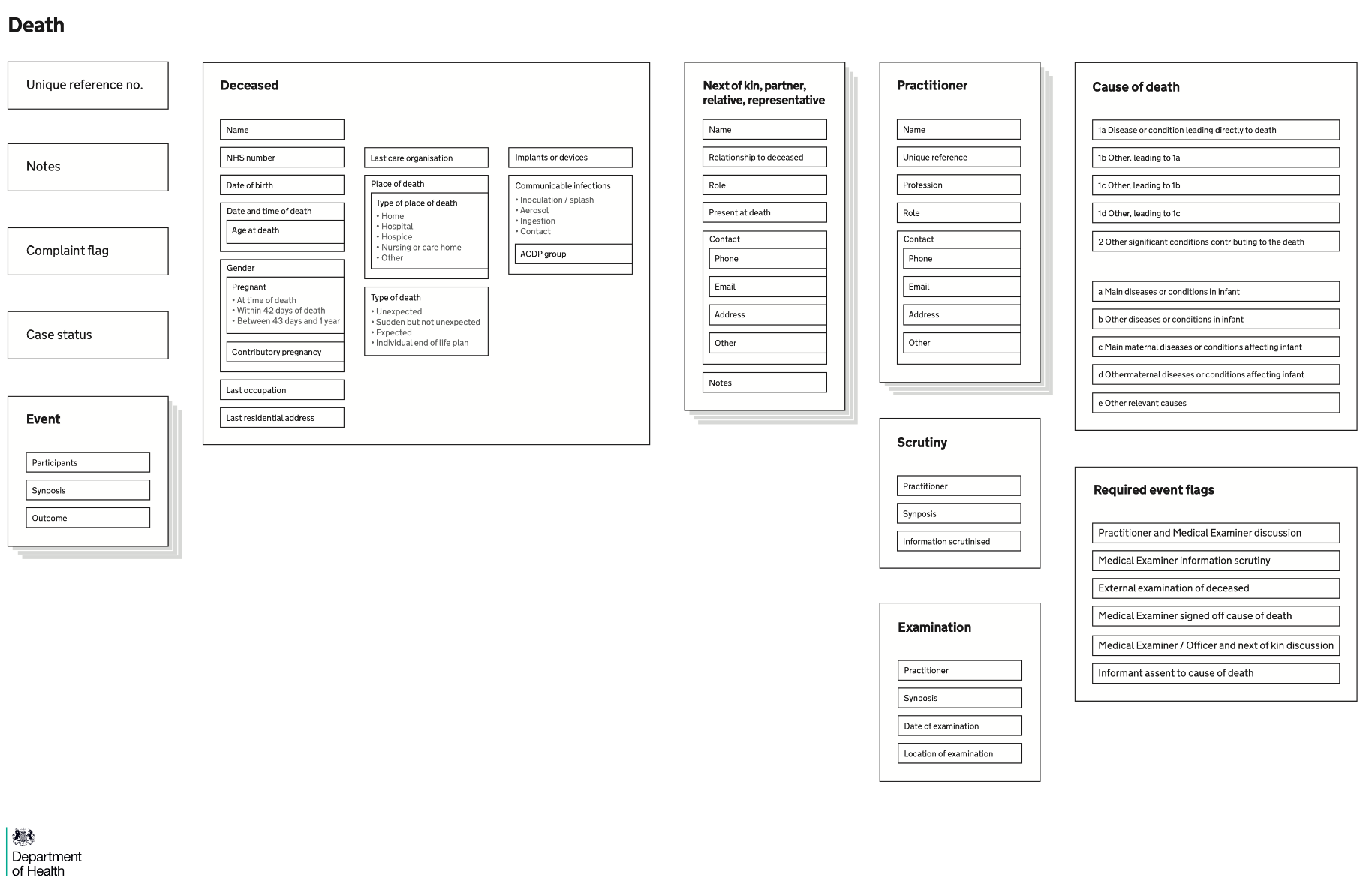
<p>Abstracting a set of paper forms into a <a href="https://github.com/department-of-health/death-data-structure/blob/master/data.pdf">model of the underlying information</a> allowed us to focus on the data any digital tooling needed to gather.</p>

<div>
  <img src="/images/me-data-model.png" alt="Diagram of the data model" />
</div>

<p>The exercise let us take a step back from the implied workflow in the <a href="https://www.england.nhs.uk/establishing-medical-examiner-system-nhs/#national-exemplar-forms">sequence of forms</a>. Instead we could think about any required events in isolation.</p>

<h3 id="blueprinting">Blueprinting</h3>

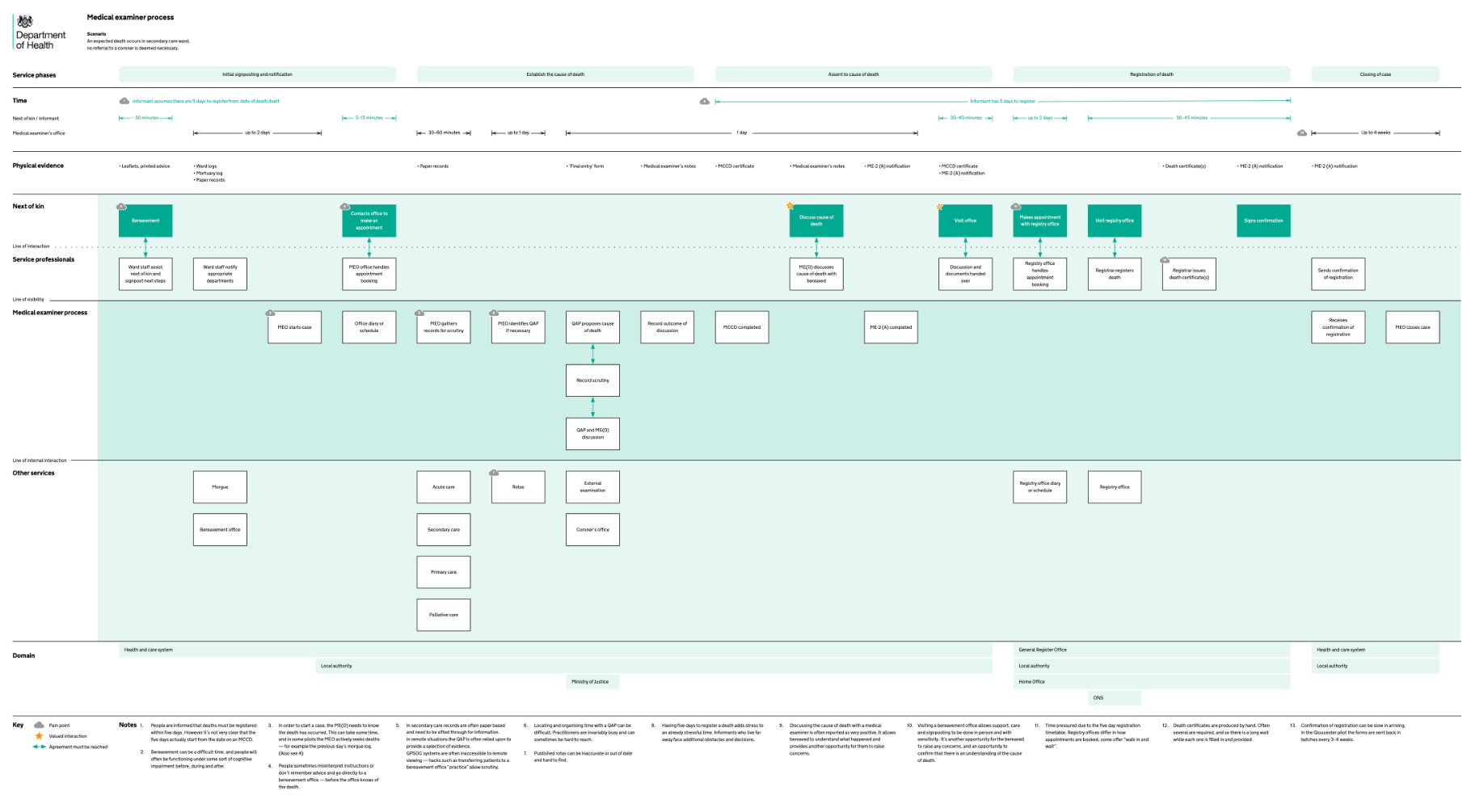
<p>The various discovery streams allowed us to produce a classic <a href="https://github.com/department-of-health/meo-process/blob/master/medical-examiner.pdf">service blueprint</a>. We used this in conjunction with the wider map in order to add more granular and operational detail to the service we were specifically concerned with.</p>

<div class="full-width">
  <img src="/images/me-service-blueprint.png" alt="Graphical service blueprint of the medical examiner process" />
</div>

<h3 id="prototype-a-digital-system">Prototype a digital system</h3>

<p>By getting into the the guts of a clinically-led service while concurrently investigating the “civilian” touchpoints involved, we had a solid understanding of the needs that had to be met by a digital product within the service.</p>

<p>While thinking about how a digital product might work, we had a few key themes in mind:</p>

<h4 id="gather-information-dont-cement-process">Gather information, don’t cement process</h4>

<p>The sequential nature of the existing policy design implied that certain events in the process had to happen in a certain order. We made sure to constantly check how necessary this was, as pilot workflows were variable and localised. We avoided cementing inflexible and universal workflow rules into our product design.</p>

<h4 id="allow-for-individuals-styles-and-differing-contexts">Allow for individuals styles and differing contexts</h4>

<p>Different practioners (for example different medical examiners) have different styles. While the information gleaned needs to be consistent, the method and style of that information is gathered can vary.</p>

<p>In a similar vein, each different case (a death) will have different contexts, possibly requiring (again) different styles from those involved.</p>

<p>Our product needed to be flexible and agnostic enough to have zero impact on differing styles and contexts.</p>

<hr />

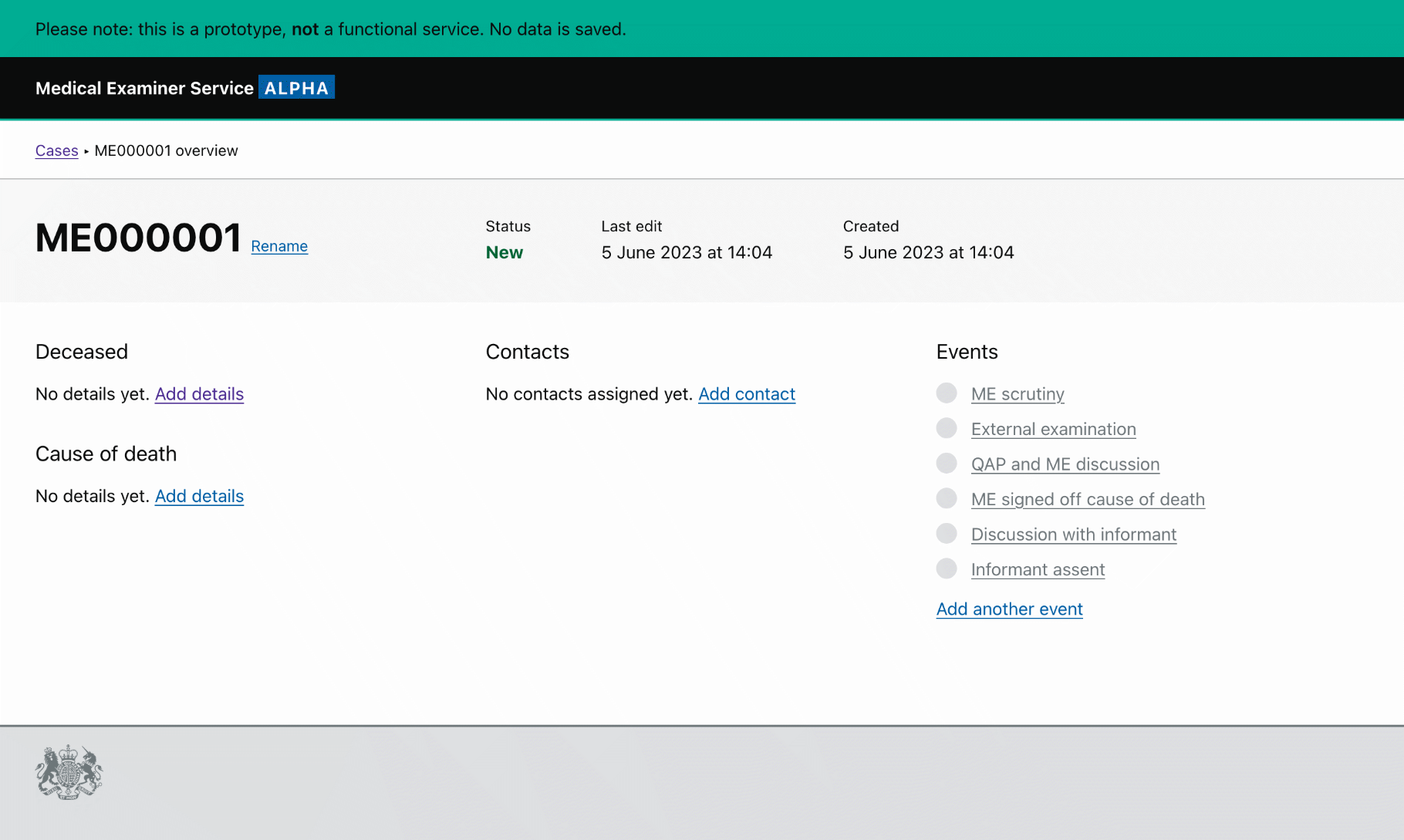
<p>We developed a small prototype to show what a digital service might look like. Our understanding from the research let us quickly sketch the bones of a system that worked intuitively and simply, while fitting the policy requirements.</p>

<div class="full-width">
  <img src="/images/me-prototype.png" alt="Screengrab of the prototype" />
</div>

<p>A strong aspect of the work was how (when tested) the prototype successfully demonstrated a detachment of required knowledge (data model) from ceremony (workflow and human interaction).</p>

<hr />

<h2 id="outcomes">Outcomes</h2>

<p>Our work was bundled into a discovery report and subsequently fed into an <a href="https://www.digitalmarketplace.service.gov.uk/digital-outcomes-and-specialists/opportunities/7249">alpha statement of work</a>.</p>

<hr />

<h2 id="thoughts">Thoughts</h2>

<p>DH Digital was really engaging and interesting. It was a lovely small team of great people, and I was able to work at multiple altitudes from high level right down into prototyping. Being inside DH meant working closely with policy and that blending felt like a very healthy way to work.</p>

<p>The death certification project in particular involved a lot of in-depth research, both at the desk, but also in person and in context. I’m thankful to all the people who made time for us in secondary and community care; the coroner’s office; and especially the bereaved who were willing to share their experience in the moment with us.</p>]]></content><author><name>Mat Johnson</name></author><category term="portfolio" /><summary type="html"><![CDATA[The brief]]></summary></entry><entry><title type="html">NOMENSA: trust in the checkout</title><link href="https://demotive.com/posts/2023/01/04/formative/" rel="alternate" type="text/html" title="NOMENSA: trust in the checkout" /><published>2023-01-04T00:00:00+00:00</published><updated>2023-01-04T00:00:00+00:00</updated><id>https://demotive.com/posts/2023/01/04/formative</id><content type="html" xml:base="https://demotive.com/posts/2023/01/04/formative/"><![CDATA[<p>My birthday comes right at the end of a year, and so in the dawn of 2023 I am feeling particularly ancient.</p>

<p>Something about getting going with my <a href="/timeline/">timeline</a> made me look back down the decades.</p>

<p>One thing I did in 2010 seems to have set a tone for what I went on to be most interested in designing over the years, so I thought I’d write about it.</p>

<h2 id="a-new-look">A New Look</h2>

<p>In 2010, I worked for a web design agency called Design UK (they’re now <a href="https://www.konstructive.com/">Konstructive</a>) and one of our clients was New Look.</p>

<p>We’d been engaged to redesign their website from end to end - the brochureware, the shopping experience, all of it.</p>

<p>Even though at the time I was a front-end dev, I’d been wanting to do a wider range of things, and was handed the checkout process to design.</p>

<p>At the time I didn’t really think “this is a seminal moment for me”, I just started wireframing (2010!).</p>

<p>And it got complicated really fast.</p>

<p>Once you get into it, it’s not easy to design a smooth checkout at all. New Look being particularly fun on the payment front, including part-payment from everything you could imagine:</p>

<ul>
  <li>pre-paid cards</li>
  <li>gift card (with a balance, you know the ones)</li>
  <li>gift vouchers</li>
  <li>discounts</li>
  <li>I swear there was more than that</li>
</ul>

<p>There was zero time; the client had read “Don’t make me think” and wanted everyone to know it; every time I thought I’d nailed it someone brought up <em>another</em> payment method; and usability testing sort of wasn’t a thing (Design UK did have an eye-tracker though). Oh, and everyone seemed to be obsessing about “one page checkouts”.</p>

<p>Anyway, I designed it. The things that preoccupied me were:</p>

<ul>
  <li>it’s got to be simple</li>
  <li>it’s got have a logical narrative</li>
  <li>any tricky bits have got to be comprehensible (think checking the balance of a gift card mid-checkout)</li>
  <li>it’s got to be reassuring</li>
</ul>

<p>Luckily my good friend <a href="https://mobile.twitter.com/adsevenfour">Andy</a> was there to smarten up the graphic design itself as I also managed to make it properly zero-fun.</p>

<h2 id="award-winning">Award winning</h2>

<p>Well not quite. But once the site was up and running, we got a good review from <a href="https://www.nomensa.com/">NOMENSA</a> in their <a href="https://www.nomensa.com/blog/trust-in-the-checkout">“Trust in the checkout”</a> report.</p>

<blockquote>
  <p>
    As New Look have demonstrated, it is possible to add the features that will make a big difference to customers’ trust and confidence, without sacrificing speed or ease-of-use. In fact, New Look gets all three right – almost undoubtedly contributing to their recent online success.
  </p>
  <cite>“Trust in the checkout” NOMENSA 2010</cite>
</blockquote>

<p>Amazingly I found the <a href="/images/nomensa-trust-in-the-checkout-2010.pdf">actual report PDF (514k).</a></p>

<h2 id="getting-to-the-point">Getting to the point</h2>

<p>At the time this was simply a really stressful bit of work. I’d been pulled out of my comfort zone noodling away in code (or “learning the medium” as I like to think) into something very much more “design”, including presenting under pressure to clients, having to create something at a silly pace, the usual agency stuff.</p>

<p>But looking back, everything that concerned me about that piece of interaction concerns me now.</p>

<p>For anything to work and be successful, it has to be simple, comprehensible, trustworthy, and solidly built. <sup><a href="#footnote-1">1</a></sup></p>

<p>The services I’ve worked on that have been most challenging, complex to design, and felt great when they <em>worked</em> have been transactional. The user has a task, whatever it might be, and the job of making that task not just achievable, but achievable with minimum pain, is something I’ve grown to love.</p>

<hr />
<p class="small">
  <sup id="footnote-1">1</sup> By “solidly built” I mean the opposite of all those pointless, poorly implemented React “apps” with shonky redraws everywhere.
</p>]]></content><author><name>Mat Johnson</name></author><category term="posts" /><summary type="html"><![CDATA[My birthday comes right at the end of a year, and so in the dawn of 2023 I am feeling particularly ancient.]]></summary></entry></feed>